














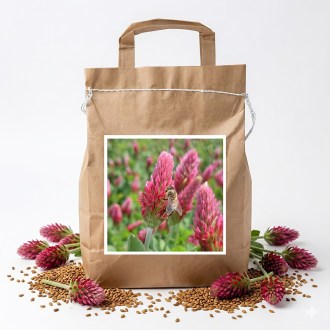


Crimson Clover CARDINAL seeds (incarnate) - 1 kg
 Sold out
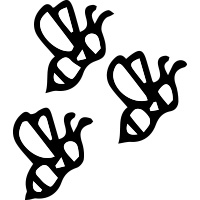
Crimson clover, Latin name Trifolium incarnatum, provides bees with both nectar and pollen. Bees collect nectar primarily during morning hours.

Crimson Clover – Premium Seed for Bees (1 kg)
Do you want a reliable honey flow for your apiary and at the same time improve the soil without unnecessary chemicals? Crimson clover (Trifolium incarnatum), also known as "Italian clover" or "scarlet clover", stands out with its bright red flowers and is among very attractive honey plants. It provides bee colonies with a natural source of nectar and pollen, thereby supporting their vitality and stable development during the season.

Why is crimson clover so important for bees?
Crimson clover (Trifolium incarnatum) is a valuable beekeeping crop thanks to the fact that it provides bees with both nectar and pollen. Bees collect nectar mainly in the morning hours. The flower nectary produces approximately 0.18 mg of nectar per 24 hours with a sugar content of around 43%. The sugar value (amount of sugar produced in the flower per 24 hours) reaches approximately 0.8 mg. Flowers produce a smaller amount of pollen, but bees willingly collect it especially in the afternoon; pollen pellets have a pinkish color. Monofloral honey from crimson clover is not usually produced, yet the crop has great importance for bees and the surrounding landscape. In practice, moreover, if there are 2–4 bee colonies near the flowering crop, the seed yield can increase by 35–40%.
Double benefit: forage for bees and green manure for soil
Sowing crimson clover brings benefits not only to bees. The plant also works excellently as green manure – the root system fixes atmospheric nitrogen, enriches the soil, improves its structure and helps reduce weed infestation. The crop also protects the soil from erosion. You thus get a nectar-producing area for pollinators and at the same time a long-term investment in soil fertility.
Growing instructions
Sowing date: second half of August. Crimson clover matures approximately around July 10.
Seeding rate: for green fodder or manure in pure culture, approximately 150–250 g / 100 m² is sown. For establishing nectar strips, 160–180 g / 100 m² is recommended.
Sowing depth: 1–2 cm.

Parameters and specifications table
| Package weight | 1 kg |
| Latin name | Trifolium incarnatum |
| Flower color | Bright red (crimson) |
| Sowing date | Second half of August |
| Maturation time | Around July 10 |
| Recommended sowing depth | 1–2 cm |
| Recommended seeding rate | 150–250 g / 100 m² (pure culture) 160–180 g / 100 m² (nectar strips) |
| Sugar value | 0.8 mg sugar / flower / 24 hours |
| Pollen pellet color | Pinkish |
| Bee influence on seed yield | Yield increase of 35–40% |
Note: Illustrative photographs show fully blooming crimson clover crop. Crop density and flower shade may vary slightly depending on soil conditions and weather during the given year.